
GEO vs SEO: How to Transform Your Search Strategy for the AI Era
Search hasn't "died" — but the surface area of discovery has exploded. Traditional SEO alone can't guarantee visibility in the AI layer. Here's how to bridge both.

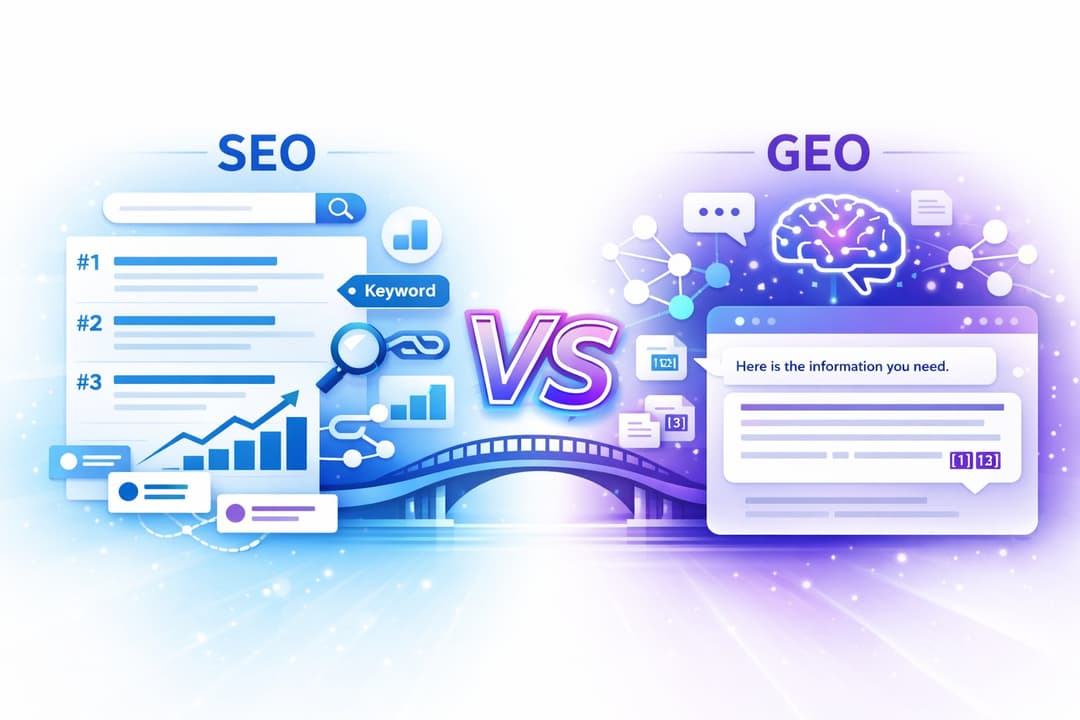
Search hasn't "died," but the surface area of discovery has exploded. Links and blue SERP listings now share the stage with AI-generated answers, summaries, and side panels that short-circuit the click entirely. Traditional SEO alone can't guarantee visibility in this new layer.
This article unpacks GEO (Generative Engine Optimization) vs SEO (Search Engine Optimization) — what's changing, what isn't, and how to practically transform your strategy so your brand shows up in both Google and AI engines.
- SEO optimizes for ranked links; GEO optimizes for cited answers inside AI-generated responses.
- SEO is still the foundation of GEO. Clear information architecture, authoritative content, and clean technical SEO are strongly correlated with AI visibility.
- GEO adds a new layer: entity clarity, machine-scannable justification (stats, quotes, sources), and strong earned-media coverage that AI engines prefer to cite.
- Generative engines favor authoritative third-party sources. Studies show AI search cites high-authority media and reference domains over brand-owned content, especially for generic queries.
- You don't replace SEO with GEO — you extend it. Winning approach: solid SEO for SERPs + GEO-aware content, schemas, and PR to earn AI citations.
- New KPIs required. Stop tracking only rankings and sessions. Start tracking citation share in AI outputs, entity coverage, and brand mentions in generative answers.
- GEO governance matters. AI can hallucinate your pricing, misrepresent your positioning, or cite you inaccurately. Someone needs to own AI visibility monitoring.
GEO vs SEO: Key Differences & Overlaps
| Area | SEO — Search Engine Optimisation | GEO — Generative Engine Optimisation |
|---|---|---|
| PRIMARY SURFACE | Google/Bing SERPs — 10 blue links, snippets, rich results | AI Overviews, ChatGPT, Gemini, Perplexity, AI sidebars |
| MAIN OUTCOME | Clicks to your site from ranked listings & snippets | Mentions, citations, recommendations inside AI-generated answers |
| VISIBILITY METRIC | Rankings, impressions, CTR, organic sessions | Citation share, answer inclusion rate, brand mentions in AI responses |
| OPTIMIZATION TARGETS | Keywords, pages, site architecture, backlinks | Entities, sources, machine-scannable explanations, structured facts, earned media authority |
| RANKING LOGIC | Link graphs + relevance + quality signals | Model training data + retrieval sources + authority priors + safety filters |
| TIME HORIZON | Months to build; relatively stable once established | Dynamic — sensitive to model updates, training cutoffs, retrieval index changes |
| WHO BENEFITS MOST | Sites with strong domain authority & good technical/content hygiene | Brands with rich multi-surface presence — owned + earned + reference sites |
What's Actually Changing in Search
Traditional featured snippets already reduced clicks. AI Overviews and chat answers often satisfy the query without any click at all. You still need visibility — but the win is now being named, not only being clicked.
Engines don't just look at the live web. They rely on training data snapshots, retrieval indexes, and curated sources. Your old content and third-party coverage can influence AI answers long after you have published.
Studies of AI search reveal systematic preference for earned media and reference domains — large publishers, government sites, well-known industry resources — especially for YMYL topics. Your brand needs to appear in those sources to be cited.
AI can still misrepresent your pricing, product positioning, or claim things you never said. That is a brand risk and a legal/compliance concern, not just a traffic issue. GEO governance is no longer optional.
How to Evolve From SEO to GEO (Without Burning Down Your SEO)
- Ask ChatGPT, Perplexity, Gemini: What is the best [your category] solution?
- Track: Are you cited? How are you described? Which sources does the AI lean on?
- Document recurring domains (top blogs, review sites, directories) — that is your GEO surface map
- Standardize brand name, product names, founders, locations across all properties
- Update key profiles: Wikipedia, Crunchbase, G2/Capterra, LinkedIn, major directories
- Use structured data (Organization, Product, Service, Person schemas) consistently
- Add clear stats, quotes, and short factual sentences AI can safely cite
- Use FAQ blocks, comparison tables, and bullet lists for discrete fact extraction
- Back every key claim with outbound citations to authoritative references
- Launch or refine a digital PR program: guest posts, expert quotes in media, independent reviews
- Target the domains that appeared repeatedly in your GEO audit — if AI trusts them, get in them
- Research what your buyers actually ask AI in your niche via user interviews and SERP features
- Build content clusters around problem-first queries — not just best [tool] or what is [term]
- Consider emerging standards like llms.txt to signal how your content can be used
- Maintain excellent crawlability, sitemaps, and schema — most AI engines use web crawling as a foundation
- Include 2–3 machine-scannable stats in every new article
- Reference at least one external authoritative source per piece
- Implement contextual schema markups on every key page
GEO vs SEO Is Not Either/Or — It Is Your New Stack
If SEO was about showing up where people search, GEO is about showing up where machines answer.
As a founder, CMO, or growth leader, your job is to:
- 01Mindset shiftAcknowledge the shift from links to language and from rankings to citations — the new currency of AI-era discovery.
- 02Visibility auditAudit your current presence in AI answers — not just your Google rankings. Ask ChatGPT, Perplexity, and Gemini about your brand directly.
- 03Content upgradeUpgrade your content and earned media to be machine-friendly and citation-worthy — clear entities, verifiable stats, and structured facts.
- 04GovernancePut governance around AI visibility — not just around ads and social. Own the monitoring and escalation when AI misrepresents your brand.
FAQs: GEO vs SEO
Mihir has 10+ years of experience in SEO and Organic Growth Marketing, with a 360 degree view across agency floors, corporate teams, and early-stage startups. He founded Search Indicators to bring AI search visibility measurement to brands navigating the generative era.
View Full ProfileRelated Articles
View All Articles →Dive deeper into modern search strategies with these hand-picked articles from our experts.
 Mihir Harchekar·4 MIN READMihir Harchekar·11 min readMihir Harchekar·9 min read
Ready to Win in AI Search?
We will audit your current SEO + GEO footprint and show you exactly where to invest first for maximum AI visibility.