
Shopify SEO
The complete playbook for Shopify store owners — from technical foundations and collection architecture to product page optimisation, content strategy, link building, and the honest pros and cons of Shopify for serious organic growth.

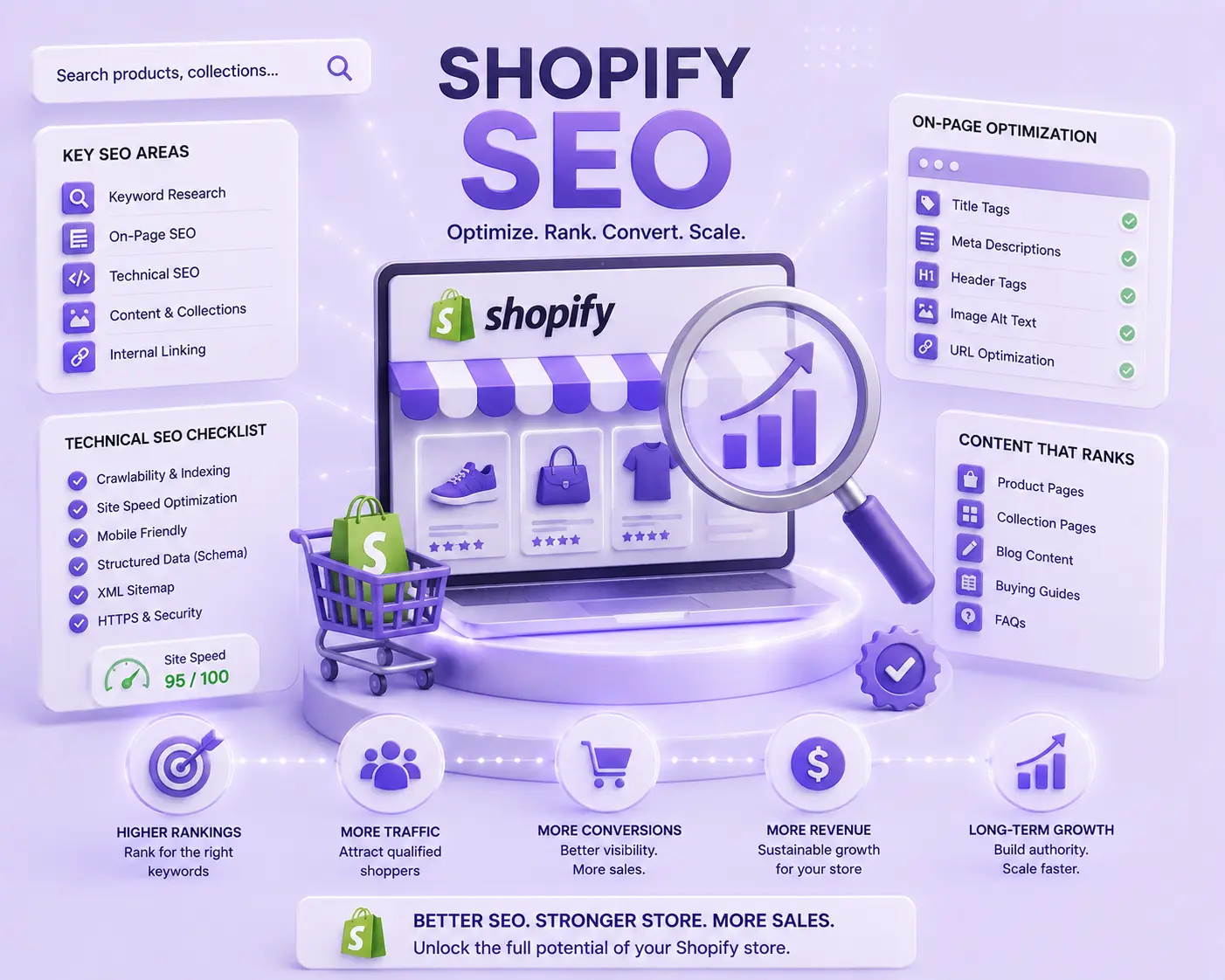
What is Shopify SEO?
Shopify holds 28% of the US ecommerce platform market. Over a million stores compete on the same platform, on the same default setup. The stores that rank aren't using a different platform — they're using the same one better.
Shopify automates the basics: sitemap.xml, robots.txt, HTTPS, and canonical tags on variant URLs. As Ahrefs puts it, Shopify handles some SEO best practices out of the box — but it is unlikely to take your store to the top of Google. Keyword research, quality content, and backlinks are still yours to do.
Every Shopify store works within fixed platform constraints. Collections sit at /collections/, products at /products/. URL structure is not fully customisable. These aren't dealbreakers — but they shape keyword architecture and mean working smarter within the structure, not against it.
Google's #1 result captures 27.6% of all clicks. But discovery now happens across Shopping panels, AI Overviews, YouTube, and Reddit. A serious Shopify SEO strategy needs presence across all of them — not only the traditional ten blue links.
Why Shopify SEO Is Your Highest-ROI Growth Channel
Paid ads stop when the budget does. SEO compounds — every improvement adds to an asset that keeps earning without a cost-per-click.
The 4 Core Pillars of Shopify SEO
Four pillars. Skip one and the others underperform — you can't compensate for broken technical foundations with more content, or for thin content with more links.
Technical SEO for Shopify Stores
Shopify automates the basics — sitemap, robots.txt, HTTPS. But three decisions require active management: preferred domain (www vs non-www), flat site structure (max 3 clicks to any product), and filter parameter blocking. Ahrefs identifies these as non-negotiables — a store with 1,000 SKUs and 5 variants can silently generate 5,000 near-duplicate pages if variant handling isn't intentional.
FOUNDATIONAL — Fix before anything elseCollection & Product Page Optimisation
Collection pages target your highest-volume commercial keywords — they're the SEO equivalent of your best shopfront windows. SEJ identifies blank collection descriptions as the most common missed opportunity — even 100 words of keyword-intentional copy outperforms a bare product grid. Ahrefs documents a 30% CTR uplift from complete Product schema with price, availability, and review data.
REVENUE-CRITICAL — Where keyword research meets conversionContent Marketing for Shopify Stores
Shopify's native blog is an authority engine when used correctly. Target informational queries buyers ask before purchasing, then link every post to the relevant collection. Backlinko cites Rothy's reaching 312K monthly visitors by combining collection SEO with informational content — blog posts earn backlinks, which flow authority to collections via internal links.
COMPOUNDING ASSET — Builds authority and mid-funnel trafficLink Building for Shopify Stores
Publishers don't link to product pages — they link to useful content. Build links to original research, data studies, and buying guides, then route that authority to your collections via internal links. Ahrefs recommends Link Intersect analysis as the fastest start: find sites already linking to two or more competitors, but not you.
AUTHORITY MULTIPLIER — What lets you compete with aggregatorsShopify SEO: Honest Pros & Cons
Based on research from Ahrefs, Search Engine Journal, and Backlinko — here is an honest, scenario-based assessment of where Shopify helps your SEO and where it creates genuine limitations you need to plan around.
The Shopify SEO Glossary
Shopify uses its own terminology for standard SEO concepts — and creates platform-specific constraints that matter for rankings. These six terms cause the most confusion in audits and agency briefs.
Shopify's equivalent of category pages on other ecommerce platforms. Collections group related products at /collections/[slug] URLs and support custom title tags, meta descriptions, and body copy — all editable from the Shopify admin.
SEJ identifies collection optimisation as the highest-value on-page work in any Shopify audit. These pages compete for head terms like running shoes — unique descriptions signal topical relevance and avoid the thin-content penalties that hit stores relying only on product grids.
A canonical tag tells Google which URL version to treat as authoritative when the same content is accessible at multiple URLs. Shopify automatically adds canonical tags to product variant URLs (?variant=id) and pages accessible via multiple collections.
Without it, a product accessible via two collections splits its ranking signals across URLs. Ahrefs notes Shopify handles most cases automatically — but verify via Search Console that the right URL is indexed, especially when custom domains are in use.
The number of pages Googlebot is willing to crawl on your site within a given timeframe. Faceted navigation filters (size, colour, price range) can generate thousands of parameterised URL variants that consume crawl budget on near-duplicate pages.
SEJ identifies filter parameter bloat as one of the most common technical failures on Shopify. Block ?color=, ?size=, and ?sort_by= in robots.txt.liquid — stop Google wasting crawls on parameter variants and direct that budget to your actual product and collection pages.
JSON-LD markup that communicates product details — name, price, availability, SKU, brand, and rating — directly to Google. Enables price, star rating, and availability to appear visually in search results as rich results above standard blue links.
A free platform that pushes your Shopify product catalogue into Google Shopping, the popular products grid in search results, and Google Images carousels. Requires the Google & YouTube app on Shopify and a verified Merchant Center account.
SEJ highlights Shopping grids now appear above organic results for most product searches. Shopify stores without Merchant Center are invisible in that position — regardless of organic rankings. Integration is free. The visibility cost of skipping it is not.
Google's quality evaluation framework. For Shopify stores, E-E-A-T signals include real customer reviews with schema, named product experts writing buying guides, authentic photography, transparent return policies, and verified business trust signals.
Backlinko identifies E-E-A-T as how independent stores outrank aggregators on specific product queries. A founder writing expert buying guides with genuine product knowledge earns higher quality ratings than anonymous catalogue copy at scale — even at lower domain authority.
How to Build a Winning Shopify SEO Strategy
Six steps in sequence. Each one enables the next — don't skip to content before fixing technical, or to link building before you have content worth linking to.
Success Metrics That Actually Matter
Rankings are a directional signal. These four metrics connect your Shopify SEO investment directly to commercial outcomes — organic sessions, revenue, and conversion performance.
The Mindset Shift Shopify SEO Requires
Most Shopify stores treat SEO as a launch task: fix the titles, submit the sitemap, wait. That misunderstands how compounding works.
Every collection page optimised with genuine keyword intent builds a foundation that doesn't expire. Every blog post that earns a backlink passes authority to your collections for years — without additional spend. Rothy's didn't reach 312,000 monthly visitors through a single sprint. They built collection authority and editorial content simultaneously until the compound effect became self-sustaining.
Shopify has real limitations: fixed URL prefixes, no nested collection hierarchies, a constrained blog engine. The brands winning in 2026 know them — and work around them strategically rather than fighting them.
The decision that separates them is simple: treat SEO as infrastructure, not a campaign. Infrastructure doesn't need a budget renewal to keep working. And unlike ads, it compounds — every improvement makes every previous investment more valuable.
Ready to Turn Your Shopify Store Into an Organic Growth Engine?
Search Indicators audits your Shopify store technical foundations, collection architecture, structured data coverage, and content gaps — and builds the SEO strategy that compounds month over month.