
Programmatic
SEO
Systems for Scalable Search Acquisition
What Is Programmatic SEO?
The goal is not to create more pages — it is to systematically satisfy repeatable user intent across searchable variables.
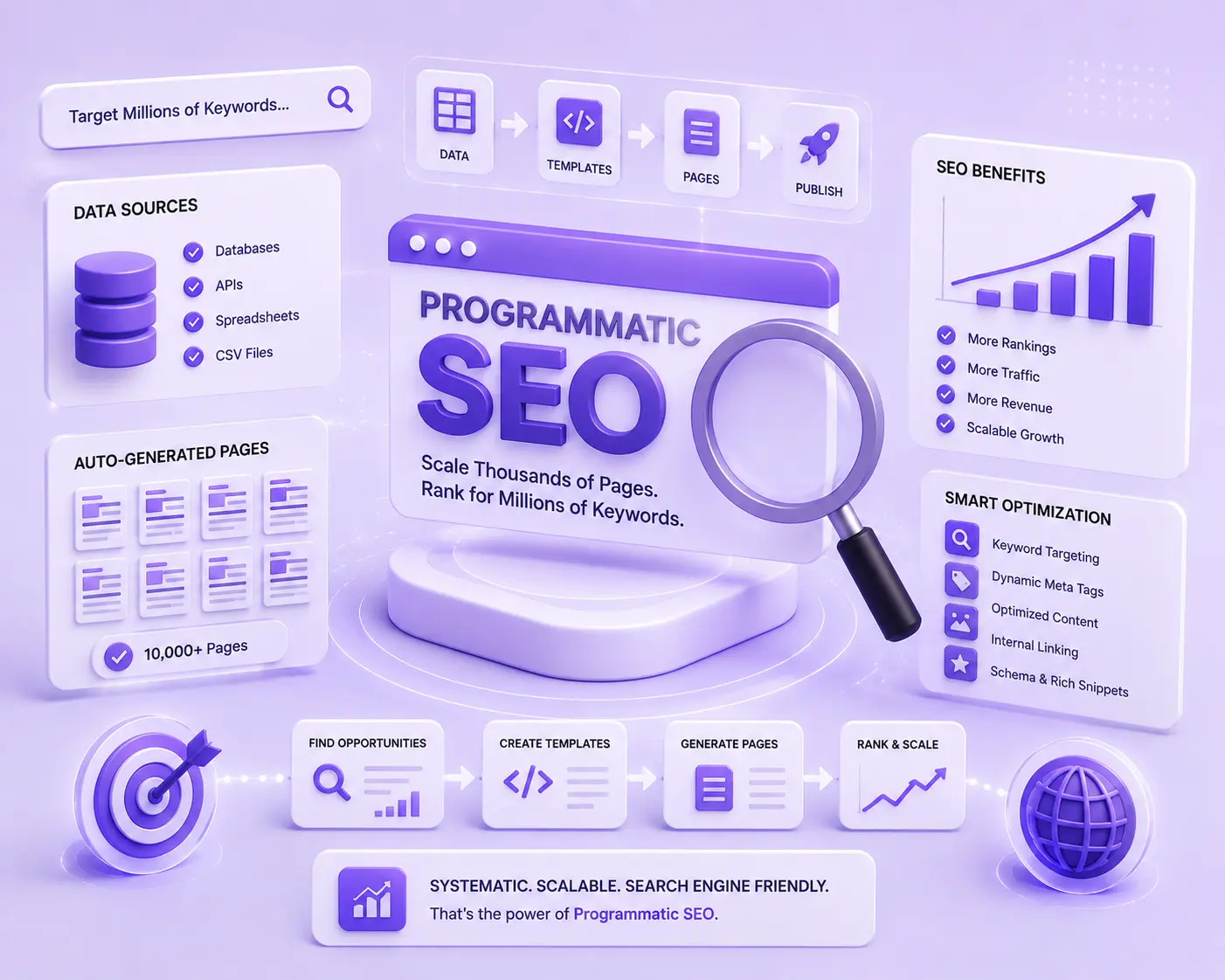
Programmatic SEO is the practice of building search infrastructure, not content volume. It combines search intent engineering with structured data, reusable templates, and automation to generate thousands of unique, useful pages at scale. Done right, the system keeps compounding — each page reinforcing the next.
"The goal is not to create more pages. The goal is to systematically satisfy repeatable user intent across searchable variables."
Mapping Search Intent to Pages
Every topic branches into dozens of search preferences. Each branch is a programmatic page opportunity waiting to be captured.
Before writing a single line of code, a successful pSEO system requires entity mapping — identifying the core topic and exhaustively branching every intent modifier a searcher might apply. Best, Compare, Pricing, Industry, Features — each branch represents a cluster of pages your competitors may already own.
The Foundation: Structured Data
The template is the skin. The database is the product.
The database is the foundation of every Programmatic SEO system. The quality, completeness, and freshness of this data determine page quality. If the database is weak, the output is weak — no template sophistication can compensate for data poverty.
The template is the skin. The database is the product.
One Template, Thousands of Pages
A single brief template fans out into hundreds of unique, indexed pages — each grounded in real keyword data.
Template logic determines how data variables render into page content. The best templates scale usefulness dynamically — each page unique in substance, consistent in structure. A single template change deploys across your entire catalogue instantly.
AI-Orchestrated Research
Autonomous agents replace manual research at every stage — scraping competitors, mining queries, identifying gaps, and producing briefs at scale.
Modern pSEO systems use AI research agents that simultaneously pull from LLMs, scrape competitor pages, mine search queries, and identify content gaps — outputting complete briefs in minutes instead of weeks. The human role shifts from researcher to systems architect.
Agents
The Content Pipeline
Four sequential phases convert raw data into indexed, revenue-generating pages.
The pipeline is deterministic: data quality gates AI orchestration, which gates assembly, which gates publication. Breaking any phase propagates failures downstream. A disciplined pipeline is what separates search infrastructure from a content spray.
Governance & Data Refresh
Scaling content means scaling quality control.
Mature platforms require governance to detect missing data, broken templates, and outdated inventory — prices, reviews, availability. Stale data is not a content issue. It is a systems failure that silently erodes crawl budget and ranking signals across thousands of pages.
Refresh & QA
"The larger the system, the more dangerous small errors become."
Internal Linking Architecture
Isolated pages are orphaned inventory. Connected pages inherit authority.
Internal linking turns isolated programmatic pages into a connected search ecosystem. Strong systems automatically link parent categories, child pages, sibling entities, and related alternatives — creating a web of signals that search engines reward.
Strong systems automatically link parent categories, child pages, sibling entities — building compounding authority paths.
Helps search engines understand entity relationships while users navigate naturally through the site.
Internal linking is how programmatic pages inherit authority instead of becoming orphaned inventory.
Good pSEO vs. Bad pSEO
The diagnostic matrix that separates search infrastructure from content spam.
Measurement & Success Metrics
Publishing volume is an output metric. Revenue from useful indexed pages is the business metric.
Success is measured by revenue per indexed page.
The 6-Step pSEO Workflow
Concept → Architecture → Engineering → Operations → Adaptation → Evolution.
The workflow is circular — systems that stop evolving lose ground. Each iteration compounds the previous, building a search moat that competitors cannot rapidly replicate. The database grows, the templates refine, and the coverage expands.
Ready to Build Your Search Infrastructure?
We design and deploy programmatic SEO systems that generate sustainable organic acquisition at scale.