LOCAL SEO PLAYBOOK 2026

Local Business SEO Guide

How small businesses rank in local search, win the Map Pack, and build lasting visibility in the age of AI-powered discovery.

Mihir Harchekar
Mihir Harchekar
Founder - Search Indicators
18 min read
June 2026
E-E-A-T Verified
Local Search
Google Business Profile
Map Pack Authority
Citation Strategy
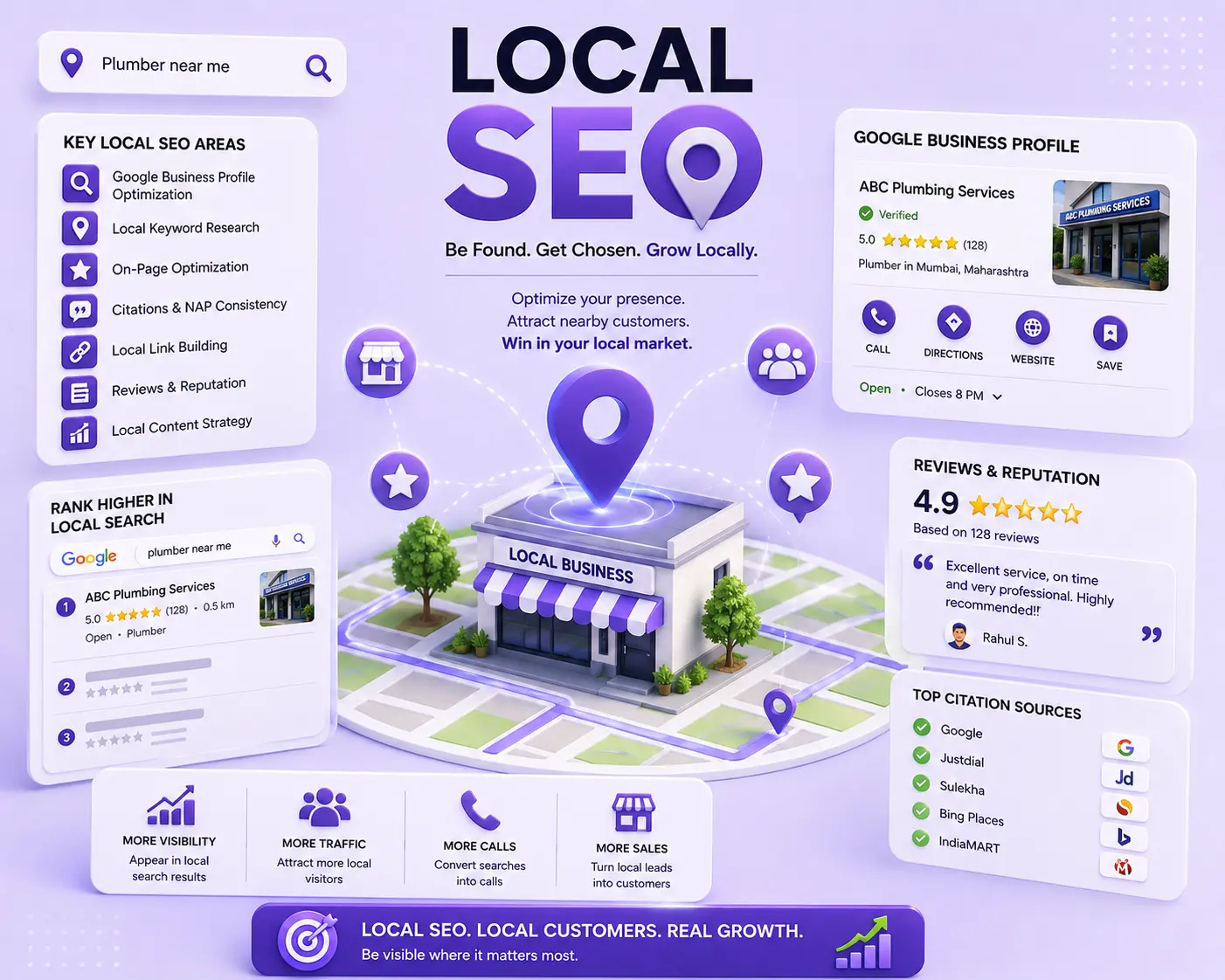
Guide Hero ImageUpload via CMS → Hero section
01DEFINITION

Local SEO is how your business becomes the answer to searches happening near you.

Local SEO is the practice of optimising your business's online presence so it appears in geographically relevant searches. It targets the Google Map Pack, local organic results, and increasingly, AI-generated location answers — not just traditional blue links.

BrightLocal's research shows that business directories alone account for 37% of organic results for local-intent terms. If your business is not listed correctly and consistently, competitors fill that space by default.

Google's three local ranking factors: Relevance (how well your listing matches the search), Distance (how far your location is from the searcher), and Prominence (how well-known and trusted your business is online). All three must be actively optimised — not just claimed.

The core mechanic is simple: Google ranks local businesses based on three factors — relevance, distance, and prominence. Most businesses optimise for only one of these, leaving significant ranking potential untapped.

02MARKET REALITY

Local search is the highest-intent traffic channel available to small businesses.

These four numbers explain why local SEO consistently delivers better ROI than paid advertising for businesses with a physical presence.

46% of all Google searches have local intent
Nearly half of every query on Google is seeking something nearby. Search Engine Roundtable analysis confirms that local intent now shapes nearly half of all search activity — and most of those searchers are in active buying mode, not research mode.
46% local intent
76% of 'near me' searchers visit within a day
Google's own consumer data confirms that 76% of people who search for something nearby on their phone visit a related business within a day. These are not passive browsers — they are ready-to-act customers at the exact moment of decision. Source: Google Think
76% same-day visits
42% of local searchers click Map Pack results
Backlinko's analysis of search behavior shows that 42% of people who conduct a local search click results inside the Google Maps Pack — making Map Pack position 1 functionally equivalent to organic rank 1 for local queries. Source: Backlinko
42% Map Pack CTR
Complete GBP = 2.7× more trusted
Google's own data reports that customers are 2.7× more likely to view a business as reputable when it has a complete Google Business Profile — and 50% more likely to consider making a purchase. Profile completeness is a trust multiplier, not a checkbox. Source: Google
2.7× reputation lift
03THE FOUR PILLARS

Local SEO success rests on four mutually reinforcing signals.

Optimising one pillar in isolation produces limited results. Businesses that dominate local search systematically address all four.

Your Google Business Profile is the command centre of local search.

BrightLocal's Local Ranking Factors survey shows 36% of SEOs rank GBP signals as the single most important factor for Map Pack rankings. Without a verified, complete profile, map pack presence is impossible. A restaurant in Mumbai with 200+ reviews, complete menu listings, and weekly posts will consistently outrank a competitor with a blank profile — regardless of website quality or domain authority.

Most critical Map Pack ranking signal
Select the most specific primary category available
Add all products and services with descriptions and prices
Upload 10+ photos (interior, exterior, team, products)
Post weekly Google Updates to signal active management
Enable messaging and respond to queries within 24 hours

NAP consistency across the web tells Google your business is real.

A NAP citation (Name, Address, Phone number) appears on directories, social platforms, and data aggregators. Whitespark's Local Search Ranking Factors places physical address accuracy among the top five local pack ranking signals. A plumbing company that lists different phone numbers across Google, Yelp, and Apple Maps creates conflicting signals — Google resolves the ambiguity by ranking more consistent competitors above them.

Foundation of local trust signals
Submit to primary data aggregators: Data Axle, Localeze, Foursquare
Claim Google, Apple Maps, Yelp, Bing Places, and Facebook
Audit and correct inconsistencies across all existing listings
Target industry-specific and local chamber of commerce directories
Monitor for duplicate listings and request removal

Your website must signal geography to rank geographically.

BrightLocal's survey shows 34% of SEOs consider on-page signals the top factor for local organic rankings. A dental practice in Bangalore that adds suburb-specific landing pages with embedded maps, LocalBusiness schema, and NAP data consistently gains ground on competitors using a single homepage for all service areas. Location signals must appear in title tags, H1s, schema markup, and the footer.

Growing in importance for local organic rankings
Add LocalBusiness schema to every location and service page
Include NAP in the footer and a dedicated contact page
Create individual service area landing pages for each suburb
Add geo-modified terms in title tags (Service + City format)
Embed Google Maps on all location and contact pages

Reviews are the fastest compounding signal in local SEO.

BrightLocal's 2026 Local Consumer Review Survey shows 75% of consumers always or regularly read reviews before visiting a local business. Review velocity — the rate at which new reviews arrive — signals to Google that a business is actively trading. A physiotherapy clinic that systematically requests reviews from every patient after each appointment can accumulate 10× the reviews of a peer business within 12 months.

17% of SEOs rank reviews as the top Map Pack signal
Create a short Google review link and share it post-service
Respond to every review — positive and negative — within 48 hours
Never incentivise or fake reviews (violates Google terms and FTC rules)
Target sector-specific platforms: Yelp, TripAdvisor, Houzz, Healthgrades
Track review velocity and aggregate rating monthly
04LOCAL SEO VS. DIRECT ADVERTISING

When local SEO dominates — and when it genuinely doesn't.

An honest comparison across eight dimensions that determine which channel wins for your business.

Aspect
Pro — When It Works Well
Con — Where It Falls Short
Cost Over Time
A local plumber who invests 6 months in GBP optimisation and citation building typically achieves compounding organic leads at near-zero marginal cost per lead — outperforming Google Ads CPC campaigns for years after the initial investment.
A new restaurant in a high-competition market may wait 3–6 months before meaningful Map Pack visibility appears. Paid advertising delivers immediate first-page placement from day one — local SEO cannot match that speed.
Speed to Results
Established local businesses with existing citations and reviews can see Map Pack movement within 4–8 weeks of GBP optimisation and structured data implementation — especially in lower-competition markets.
For brand-new businesses with zero reviews, no citations, and no website authority, local SEO takes 4–6 months to produce meaningful traffic. Paid visibility is the only viable bridge during this period.
Multi-Location Scale
Enterprise brands with 50+ locations can systematically deploy local landing pages, schema, and GBP management processes — turning local SEO into a scalable, owned-channel growth engine that compounds across every location.
Managing NAP consistency, review velocity, and GBP accuracy across 200+ locations requires dedicated tooling (BrightLocal, Yext) and significant operational investment to avoid conflicting signals.
Competition Level
In low-competition niches and secondary cities, thorough GBP optimisation and 20+ reviews can dominate the local pack. The bar is surprisingly low in many industries and geographies — even modest effort produces strong results.
In high-competition verticals (lawyers, dentists, plumbers in metro cities), ranking in the Map Pack top 3 demands significant domain authority, review quantity, and geographic proximity — local SEO alone is often insufficient.
Review Dependency
Businesses with excellent service cultures naturally accumulate strong review profiles over time — a sustainable, authentic trust signal that paid advertising cannot replicate or purchase legitimately.
Negative reviews can directly damage Map Pack rankings. A single bad service month with five negative reviews can undo months of optimisation work — local SEO is uniquely vulnerable to reputation events.
AI-Generated Answers
Businesses with complete, consistent GBP profiles and high review scores are increasingly cited in AI-generated local answers (ChatGPT, Perplexity, Gemini) — extending visibility beyond traditional search results at no extra cost.
AI search results for local queries are highly proximity-dependent. A business outside the AI-perceived service area may not appear in AI recommendations even with perfect optimisation and strong reviews.
Long-Term Authority
A local business with 3+ years of consistent NAP data, GBP posts, and review accumulation builds durable authority that new competitors cannot replicate quickly — a genuine structural competitive moat.
Established competitors with 500+ reviews and high domain authority represent a structural disadvantage. Overcoming entrenched local authority takes years of consistent investment in organic local SEO alone.
Tracking & Attribution
GBP Insights tracks direction requests, calls, and website clicks. Google Search Console adds impression and click data by keyword — providing measurable, channel-specific attribution for local SEO investment.
Last-click attribution misses walk-in visits triggered by Map Pack visibility. Without call tracking or CRM integration, the true ROI of local SEO is consistently underreported to decision-makers.
05KEY TERMS

The six terms that define local search performance.

Understanding these concepts is the difference between treating local SEO as a setup task and treating it as an ongoing growth channel.

Map PackGoogle's Local 3-Pack
What it means

The three business listings and map that appear at the top of Google search results for local queries. Backlinko's analysis shows 42% of local searchers click results inside the Map Pack — making it the most valuable real estate in local search, above even organic position 1.

Why it matters

Appearing in the Map Pack for your primary service keyword can triple monthly inbound leads. It requires a verified GBP, consistent NAP data, sufficient review volume, and proximity to the searcher — not just a website.

NAPName, Address, Phone Number
What it means

The consistent presentation of your business's core identity across every online directory, social platform, and data source. Even minor inconsistencies — an old suite number, a disconnected phone, a slightly different business name — send confusing signals to Google's local algorithm.

Why it matters

Whitespark's ranking factors data places physical address accuracy among the top five local pack signals. A business with 50 consistent citations outranks a competitor with 200 inconsistent ones — consistency beats volume.

GBPGoogle Business Profile
What it means

Google's free business listing tool (formerly Google My Business) that controls what appears in the Map Pack and Google Maps — including reviews, hours, photos, Q&A, posts, products, and services. Google states complete profiles are 50% more likely to drive purchase consideration.

Why it matters

36% of SEO professionals rank GBP signals as the single most important factor for Map Pack rankings. A business without a verified, fully optimised GBP is invisible in local search — regardless of how good its website is.

CitationOnline Business Listing
What it means

Any online mention of your business's NAP information — on a directory (Yelp, Yellow Pages), data aggregator (Data Axle, Localeze), or social platform (Facebook, Instagram). Citations are both direct ranking signals and independent discovery channels that appear in local SERPs.

Why it matters

BrightLocal research shows business directories account for 37% of organic results for local-intent searches. Missing key directories means competitors fill those results — and those directory pages drive direct traffic too.

ProximitySearch-to-Business Distance Signal
What it means

One of Google's three core local ranking factors (alongside relevance and prominence). Google gives stronger Map Pack placement to businesses physically closer to the point of search — a search from one suburb can return completely different results than the same query from a neighbouring suburb two kilometres away.

Why it matters

Proximity explains why Map Pack rankings vary dramatically by location. Businesses on the edge of their service area see competitors dominate at their periphery — making accurate service area configuration and suburb-specific landing pages critical to full-area coverage.

Review VelocityRate of New Review Accumulation
What it means

The speed at which a business accumulates new reviews over time. A business receiving 3–5 new Google reviews per week signals active, ongoing trading to both Google's algorithm and potential customers evaluating whether the business is still open, relevant, and trustworthy.

Why it matters

BrightLocal's 2026 Consumer Review Survey shows 75% of consumers regularly read reviews before visiting. Review velocity signals recency — 10 reviews from this month are more powerful than 100 reviews from 2021.

Ready to dominate your local market?
Search Indicators builds local SEO strategies that compound over time — citation authority, GBP management, and on-page localisation working together.
See our approach
06THE 6-STEP PLAYBOOK

Six steps to build a local SEO foundation that compounds.

These steps are sequenced intentionally — each one amplifies the next. Most businesses skip to step 4 and wonder why they see no results.

01
Claim and fully complete your Google Business Profile
Google's own data shows complete profiles are 2.7× more likely to be viewed as reputable and 50% more likely to drive consideration. Most businesses stop at the basics — name, address, category. The businesses that dominate the Map Pack complete every field: products, services with pricing, attributes, 10+ photos, FAQs, and weekly Google Posts. A beautician in Chennai with detailed services, 40+ photos, and weekly posts consistently outranks established salons with blank profiles — profile depth is a direct ranking signal.
GBP OptimisationVerificationGoogle PostsBusiness Photos
02
Nail NAP consistency across all citation sources
Whitespark's Local Search Ranking Factors places physical address in the city of search as the fourth most impactful local pack signal. Start with the primary data aggregators — Data Axle, Localeze, and Foursquare — which feed hundreds of downstream directories. A single incorrect phone number submitted to one aggregator can propagate inconsistencies across 50+ sites, silently diluting local authority for months before the problem is diagnosed.
NAP ConsistencyData AggregatorsCitation AuditDirectory Listings
03
Build a review acquisition system — not a one-off request
75% of consumers regularly read reviews before visiting a local business, per BrightLocal's 2026 survey. A dentist who emails every patient a review link 24 hours after their appointment — using a two-step message sequence — typically achieves a 15–25% conversion rate versus 2–3% for verbal requests. The system matters more than the individual ask. Build it once, let it run passively, and review velocity compounds month over month.
Review AcquisitionGBP ReviewsReputation ManagementEmail Automation
04
Create geo-specific landing pages for every service area
34% of local SEO professionals consider on-page signals the top factor for local organic rankings. A single homepage cannot rank simultaneously for 'plumber in Bandra' and 'plumber in Juhu' — Google needs separate, unique pages for each area. Each service area page requires a distinct URL, unique content (200+ words, not duplicated), an embedded map, LocalBusiness schema, and the full NAP. A plumbing company with 8 suburb-specific pages typically captures 3–5× more local organic traffic than one with a single service area paragraph on their homepage.
Service Area PagesSchema MarkupGeo-Modified KeywordsLocal Landing Pages
05
Build local backlinks from community sources
BrightLocal's survey shows 31% of SEO professionals consider links the most important signal for local organic rankings. Local backlinks — from your chamber of commerce, local news coverage, event sponsorships, and industry associations — carry geographic relevance that generic links lack. A yoga studio that sponsors a local 5K earns a link from the race website, a citation from the event listing, and a mention in the local newspaper — three signals a national competitor cannot replicate.
Local Link BuildingCommunity PRSponsorshipsChamber of Commerce
06
Implement LocalBusiness schema on every relevant page
Structured data from schema.org's LocalBusiness type tells Google exactly what your business is, where it operates, and what it offers — in machine-readable format. A restaurant with complete schema (business type, address, opening hours, menu URL, aggregate rating) is eligible for rich results and is more parseable by AI search systems like Perplexity and ChatGPT. The common failure is adding schema once and forgetting it — hours change, phone numbers update, and stale schema creates discrepancies that actively hurt rankings.
Schema.orgLocalBusiness SchemaJSON-LDRich ResultsAI Search
07PERFORMANCE TRACKING

The four metrics that tell you whether your local SEO is actually working.

Vanity metrics like website sessions hide poor local SEO performance. Track these four instead.

Map Pack Position
Your average ranking within Google's 3-Pack for primary service keywords. Track by keyword and by suburb — position 1 in the Map Pack captures dramatically more traffic than positions 2 or 3. Use BrightLocal's Local Search Grid or Grid My Business to visualise position heat maps across your full service area.
Local Pack pos. 1 CTR
42%
Organic pos. 1 CTR
31%
Local Pack pos. 2–3 CTR
18%
GBP Profile Actions
Google Business Profile Insights tracks four key actions: website clicks, direction requests, phone calls, and message starts. These are direct revenue signals. A 20% month-on-month increase in direction requests correlates directly with increased foot traffic — more reliably than any website analytics metric for physical businesses.
Direction requests (highest intent)
Foot traffic
Phone calls (direct contact)
Immediate lead
Website clicks (research stage)
Consideration
Review Velocity & Star Rating
Track both the number of new reviews per month and your average star rating separately. Review velocity signals active trading; star rating signals service quality. A target of 4+ new Google reviews per month is a realistic minimum for maintaining recency signals in most markets — dropping below this signals inactivity to both Google and potential customers.
Consumers who always read reviews
75%
Trust Google as top review source
66%
Min. star rating to consider visiting
4.0★+
Local Organic Traffic
Monitor organic search traffic from geo-modified keywords in Google Search Console — filtering queries containing your city, suburb, and 'near me' terms. This shows whether your service area pages and on-page localisation are building organic traffic independent of Map Pack clicks. Healthy local SEO shows both Map Pack and organic traffic growing simultaneously.
Mobile local searchers → store visit (week)
88%
Local search → purchase within a day
20%
Mobile users contacting biz from search
60%
08THE LOCAL VISIBILITY MINDSET

The businesses that win local search treat it like customer service — not marketing.

Most local businesses approach SEO as a one-time setup task. They claim their GBP, add their address, and wait. The businesses that consistently rank in the Map Pack treat local SEO as an ongoing customer relationship signal — every review response, every GBP post, every citation update is a trust deposit that compounds over time.

The best local ranking signal is a business that actively serves its local community. A hair salon that responds to every review, posts weekly photos, and maintains accurate hours through every holiday is sending constant signals to Google that it is active, trusted, and relevant. These are not SEO tactics — they are good business habits with significant SEO benefits.

AI-powered local search is accelerating this dynamic. ChatGPT, Perplexity, and Google's AI Overviews increasingly surface local business recommendations — drawing primarily from GBP data, review signals, and consistent entity information. The businesses building structured local authority today will hold a structural advantage as AI-driven local discovery becomes the default.

The compound effect is what separates local SEO from every other marketing channel. Paid ads stop delivering the moment the budget ends. Local SEO authority — reviews, citations, GBP completeness, backlinks — does not expire. Each month of consistent effort adds to a base that grows without proportional additional spend.

Key insight: Local SEO's biggest advantage over paid advertising is that it compounds. Each new review, each citation, each month of consistent GBP management adds to a base that grows without additional spend. Paid visibility stops the moment your budget ends — local SEO authority does not.
The businesses that rank locally are not winning with tactics — they are winning with consistency.
Search Indicators Local SEO Framework
Build your local strategy
READY TO OWN YOUR LOCAL MARKET?

Local search visibility that compounds every month.

Search Indicators helps local businesses rank in the Map Pack, build citation authority, and turn local search into a predictable, owned growth channel.