Complete Playbook — 15 min read

Ecommerce SEO

A strategic playbook for turning organic search into your highest-ROI acquisition channel — built for brands competing across Google Shopping, AI Overviews, and multi-surface discovery.

Mihir Harchekar
Mihir Harchekar
Founder - Search Indicators
15 MIN READ
JUN 2026
Ecommerce SEO
Organic Growth
Conversion Strategy
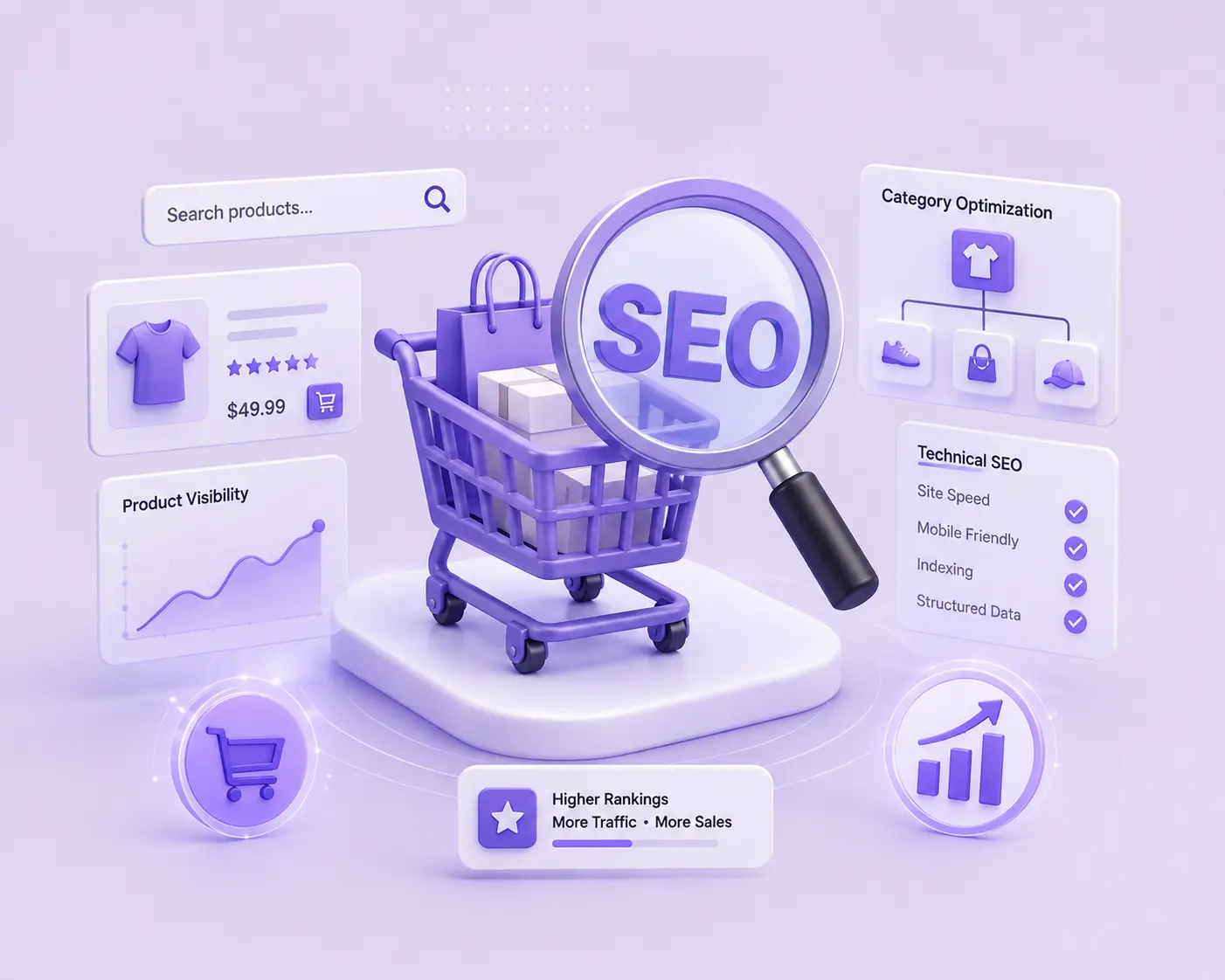
Guide Hero ImageUpload via CMS → Hero section
01FOUNDATION

What is Ecommerce SEO?

Ecommerce SEO is the process of optimising your online store — its category pages, product pages, technical infrastructure, and content — to rank higher in organic search results and capture purchase-intent traffic without paying for every click.

Unlike paid search, where visibility stops the moment you pause your budget, SEO compounds. A well-optimised category page keeps driving qualified buyers for months or years after the initial investment. That compounding is what makes organic search the single highest-ROI acquisition channel in ecommerce.

Ecommerce SEO defined: Ecommerce SEO is the discipline of making your products findable at the exact moment buyers are ready to purchase — across Google, AI shopping assistants, and every surface where intent converts.

In 2026, ecommerce SEO has expanded well beyond Google blue links. Google Search Central now covers product structured data, Google Shopping surfaces, AI Overviews, and multi-surface discovery — because your products need to appear wherever your buyers are looking, not just on page one.

Ahrefs identifies category and product pages as the commercial core of ecommerce SEO — these pages capture queries with the highest purchase intent and the highest revenue potential per ranking position.

02GROWTH CASE

Why is Ecommerce SEO Critical for Growth?

Organic search drives 43% of all ecommerce traffic and converts at 2.8% on average — higher than display, social, and most paid channels. It is the one acquisition channel that gets more efficient as it compounds.

The Dominant Traffic Channel
Organic search drives more traffic to ecommerce stores than any other channel — paid, social, or email. Brands that build strong SEO foundations turn Google into a 24/7 sales engine that operates without incremental cost per click.
43% of all ecommerce traffic — the single largest source
The Highest Long-Term ROI
SEO compounds in a way no paid channel can match. Unlike PPC where every pause kills visibility, organic rankings persist. Once built, category authority keeps delivering without proportional cost increase — month after month.
317% average ROI with a 9-month break-even
AI Search Changes the Stakes
Organic CTR dropped 61% for queries with AI Overviews — but brands cited inside AI answers see up to 35% traffic lift. Ecommerce SEO in 2026 must win both the traditional ranking and the AI citation, or cede the discovery layer entirely.
35% traffic lift from a single AI Overview citation
Orders, Not Just Traffic
Organic search drives transactions — not just awareness. Nearly one in four ecommerce orders is influenced by organic search, touching every stage of the buyer journey from discovery through to final purchase.
23.6% of all online orders influenced by organic search
03FRAMEWORK

The 4 Core Pillars of Ecommerce SEO

Google Search Central identifies four interdependent systems for ecommerce visibility. Strong performance across all four is what separates stores that compound organic growth from those that plateau at page two.

Technical SEO

Ecommerce sites face unique technical challenges. Faceted navigation — the filter systems that let users sort by size, colour, and price — generates thousands of duplicate URL variants that confuse crawlers, split link equity, and waste crawl budget. Ahrefs identifies this as the number-one technical issue for ecommerce. Google Search Central covers URL structure, canonicalization, and pagination management specifically for ecommerce stores.

FOUNDATIONAL — Fix before anything else
Faceted navigation — canonicals, noindex, and crawl budget management
Core Web Vitals: LCP, CLS, INP across product and category pages
XML sitemaps with product and image URLs
URL structure per Google Search Central ecommerce guidelines
Pagination handling — correct load-more and infinite scroll patterns
Mobile-first indexing compliance for product images and filters
HTTPS, redirect chains, and crawl error resolution

Page Optimisation

Ecommerce on-page SEO operates at two levels: category pages targeting fat-head, high-volume queries, and product pages targeting long-tail purchase-intent queries. Category pages are your highest-leverage organic assets — they capture broad searches and funnel buyers into products. Product pages need unique descriptions, rich media, and review content to differentiate from manufacturer copy that tanks rankings.

REVENUE-CRITICAL — Where SEO meets conversion
Category page H1, title tag, and meta description optimised for head terms
Unique product descriptions — no manufacturer copy
Keyword-mapped URL structure: /category/subcategory/product
Product image optimisation — alt text, WebP format, image sitemaps
Breadcrumb navigation for UX and crawl path clarity
Internal linking from category to subcategory to product
CTA placement and trust signals for BOFU conversion

Structured Data

Google Search Central identifies Product, Offer, AggregateRating, BreadcrumbList, and FAQPage schema as critical for ecommerce visibility. Structured data unlocks rich results — price, availability, and star ratings visible directly in search — lifting CTR without changing rankings. In the AI era, complete schema also feeds product data into AI Overviews, where brands with structured data get cited and those without do not.

VISIBILITY MULTIPLIER — Unlocks rich results
Product schema with name, price, availability, and SKU
AggregateRating schema with verified review count and score
BreadcrumbList schema across all category and product pages
Merchant listing with return policy and shipping policy markup
FAQPage schema on category pages for featured snippet capture
Organization and website schema at domain level
Product variant markup for multi-SKU products

Authority & Content

Topical authority in ecommerce means owning the informational layer above your products — buying guides, comparison content, how-to resources, and category expertise that earns links, builds trust, and signals authority to Google. Search Engine Land notes that AI-driven discovery reshapes this layer: buyers research with conversational queries before purchasing, and the brands that answer those questions capture the downstream transactional intent.

COMPOUNDING MOAT — Harder for competitors to copy
Category-level buying guides and product comparison content
Product-adjacent how-to and use-case content
Original research and data assets to earn editorial backlinks
Digital PR for high-authority link acquisition
User-generated content — reviews and Q&A — for E-E-A-T signals
Expert author bylines and brand entity signals
Quarterly content refresh cycles for seasonal and trending queries
05GLOSSARY

The Ecommerce SEO Glossary

Ecommerce SEO has its own vocabulary — from technical faceted navigation to commercial structured data schemas. Here is what every growth marketer needs to understand to execute and report effectively.

Faceted NavigationFilter-Generated URL Variants
What it means

The filter and sorting systems on ecommerce sites — size, colour, price, brand — that generate unique URLs for every combination, often creating thousands of near-duplicate pages.

Why it matters

The number-one technical SEO issue for ecommerce according to Ahrefs. Without proper canonicalization or noindex directives, faceted URLs waste crawl budget, split link equity, and trigger duplicate content issues.

Product SchemaProduct Structured Data (Schema.org)
What it means

Structured data markup that tells Google the name, price, availability, SKU, and ratings of a product — enabling rich results with price and star ratings visible directly in search.

Why it matters

Google Search Central identifies Product and Offer schema as foundational for ecommerce. Rich results lift CTR by 20-30% without changing ranking position — a direct revenue lever.

Category PageCollection Page or Product Listing Page (PLP)
What it means

The page grouping products under a shared category — e.g. /running-shoes. These pages target high-volume, fat-head queries with broad purchase intent.

Why it matters

Category pages are the highest-leverage organic assets in ecommerce according to Ahrefs. They capture search volume and funnel buyers to products. Neglected category pages are the most common missed revenue opportunity.

E-E-A-TExperience, Expertise, Authoritativeness, Trustworthiness
What it means

Google quality evaluation framework applied through Search Quality Rater guidelines. For ecommerce, this means genuine product expertise, real reviews, transparent business information, and identifiable authors.

Why it matters

E-E-A-T signals determine whether Google treats your product and buying guide content as authoritative — directly impacting ranking position for competitive commercial queries.

Search IntentBuyer Intent or Query Intent
What it means

The underlying goal behind a query — informational (learning), commercial investigation (comparing options), or transactional (ready to buy). Each intent stage requires a different page type.

Why it matters

Mapping keywords to the correct intent stage is foundational to ecommerce SEO architecture. Wrong intent matched to wrong page type means right traffic at the wrong moment — no conversion.

AI OverviewGoogle Generative AI Search Summary
What it means

AI-generated answers at the top of Google results synthesizing information from multiple sources — reducing organic CTR for informational queries by up to 61% on average.

Why it matters

Brands cited inside AI Overviews see up to 35% traffic lift. Ecommerce SEO must now win both the ranking and the AI citation. Structured data and authoritative content are the primary levers for citation.

How does your store's organic visibility stack up against competitors?
Search Indicators audits your category architecture, structured data coverage, and organic share of voice — and maps your biggest growth opportunities.
Get Free Audit
06PLAYBOOK

How to Build a Winning Ecommerce SEO Strategy

Six moves executed in sequence — each building the foundation for the next. From technical infrastructure to compounding authority that AI search engines cite and buyers trust.

01
Resolve Technical Debt Before Adding Content
Audit and fix faceted navigation, crawl budget issues, duplicate product URLs, and Core Web Vitals before publishing new content. Technical problems compound at scale — a 10,000 SKU store with broken faceted navigation can generate 200,000+ indexable URL variants diluting every ranking signal you own. Use Google Search Console Index Coverage and Ahrefs Site Audit to prioritize fixes.
Technical AuditFaceted NavigationCrawl BudgetCore Web Vitals
02
Map Every Keyword to Exactly One Page Type
Each keyword belongs on precisely one page type — category, subcategory, or product. Broad terms like running shoes belong on category pages. Long-tail terms like a specific product review belong on product or buying guide pages. Mapping this architecture before creating content prevents cannibalization where multiple pages compete for the same query and split ranking authority.
Keyword MappingArchitectureIntentCannibalization
03
Optimise Category Pages for the Fat Head
Category pages are the commercial core of ecommerce SEO. Per Semrush category page guidance, each must have a compelling H1 with the target keyword, unique category description above or below the product grid, breadcrumb navigation, and internal links to subcategories and top products. These pages target your highest-volume, highest-revenue queries — invest disproportionately here before anywhere else.
Category PagesFat-Head QueriesInternal LinkingSemrush
04
Deploy Full Structured Data Coverage Across Every Page
Implement Product, AggregateRating, BreadcrumbList, and Merchant Listing schema across every product and category page — following Google Search Central ecommerce structured data documentation. Rich results with price, availability, and star ratings in search lift CTR 20-30% without changing rank. In 2026, structured data also feeds AI Overview citations — brands with complete schema appear in AI answers; those without are invisible.
Structured DataProduct SchemaRich ResultsGoogle Search Central
05
Build Topical Authority Above Your Products
Create buying guides, comparison pages, and how-to content answering the research questions buyers ask before purchasing. These informational pages earn editorial links that category pages rarely attract, build topical authority signals, and capture commercial investigation intent. Search Engine Land notes that AI-driven discovery reshapes this layer — buyers research with conversational prompts that informational content answers better than product pages.
Buying GuidesTopical AuthorityContent StrategyLink Building
06
Report on Organic Revenue, Not Rankings
Ecommerce SEO must connect directly to business outcomes. Set up organic revenue attribution in GA4 with ecommerce tracking. Monitor assisted conversions — organic search often influences purchases attributed to later touchpoints. Report organic revenue, organic transaction volume, and cost per organic order to leadership — not keyword positions, which tell you nothing about commercial performance.
GA4Revenue AttributionAssisted ConversionsReporting
07MEASUREMENT

Success Metrics That Actually Matter

Ecommerce SEO reporting must connect organic performance to commercial outcomes. Rankings and traffic are directional signals — organic revenue and conversion rate are the real scorecards your leadership team will respect.

Organic Revenue & Transaction Volume
The primary commercial KPI — total revenue and orders attributed to organic search in GA4. Organic search converts at an average of 2.8% for ecommerce, higher than display and social. Revenue per organic session reveals quality beyond volume.
Revenue goal attainment
72%
YoY organic order growth
+88%
Category Page Organic Share of Voice
The share of total impressions in your product category your store captures across Google — measured via Search Console for category-level queries. Share of Voice contextualises absolute traffic against the total available, revealing whether you grow faster or slower than your market.
Category SoV (organic)
34%
Target SoV — 12 months
58%
Structured Data & Rich Result Coverage
Percentage of product and category pages with valid Product, AggregateRating, and BreadcrumbList schema. Pages with complete structured data earn rich results — price, stock, and review stars — lifting CTR 20-30% versus text-only results. Monitor via Google Search Console Rich Results report.
Product schema coverage
91%
Rich results eligible pages
84%
Core Web Vitals Pass Rate
Percentage of product and category page URLs passing Google Core Web Vitals thresholds — LCP under 2.5s, CLS under 0.1, INP under 200ms. Google confirmed in 2025 that CWV weighting increased. On competitive commercial queries where content relevance is equal, the faster store wins.
Desktop CWV pass rate
95%
Mobile CWV pass rate
78%
08CLOSING THOUGHT

The Mindset Shift Ecommerce SEO Requires

The biggest mistake ecommerce brands make with SEO is treating it as a one-time project. A site audit, a content sprint, a backlink campaign — then waiting six months to see if anything moved. That is not how organic search works.

Ecommerce SEO is infrastructure. Like your warehouse system or your payment stack, it requires consistent investment, ongoing maintenance, and iterative optimisation across technical health, page quality, structured data, and authority.

The brands winning organic search in 2026 started investing in 2024. They have category authority that took 12 months to build, backlink profiles that cannot be replicated in 90 days, and structured data feeding their products into AI Overviews their competitors are not even tracking.

The shift is from treating SEO as a cost to treating it as a compounding asset. Every optimised category page, every piece of authoritative buying guide content, every structured data implementation — adds to a growing organic footprint that delivers purchase-intent traffic without paying for every click, indefinitely.

The compounding reality: Your competitors are not standing still. Every month you delay building organic infrastructure, they compound their category authority further ahead — and the gap becomes progressively harder to close.
The best time to invest in ecommerce SEO was 18 months ago. The second best time is right now — before your competitors extend the lead any further.
— Mihir Harchekar, Founder, Search Indicators
Book a Strategy Call
get started

Ready to Turn Organic Search Into Your Highest-ROI Channel?

Search Indicators audits your ecommerce SEO foundation — category architecture, structured data, technical health, and organic share of voice — and builds the strategy that compounds month over month.