
Automotive SEO
The complete playbook for dealerships, repair shops, and automotive brands to win organic search — from local presence and inventory architecture to structured data, video SEO, and AI-era discovery.

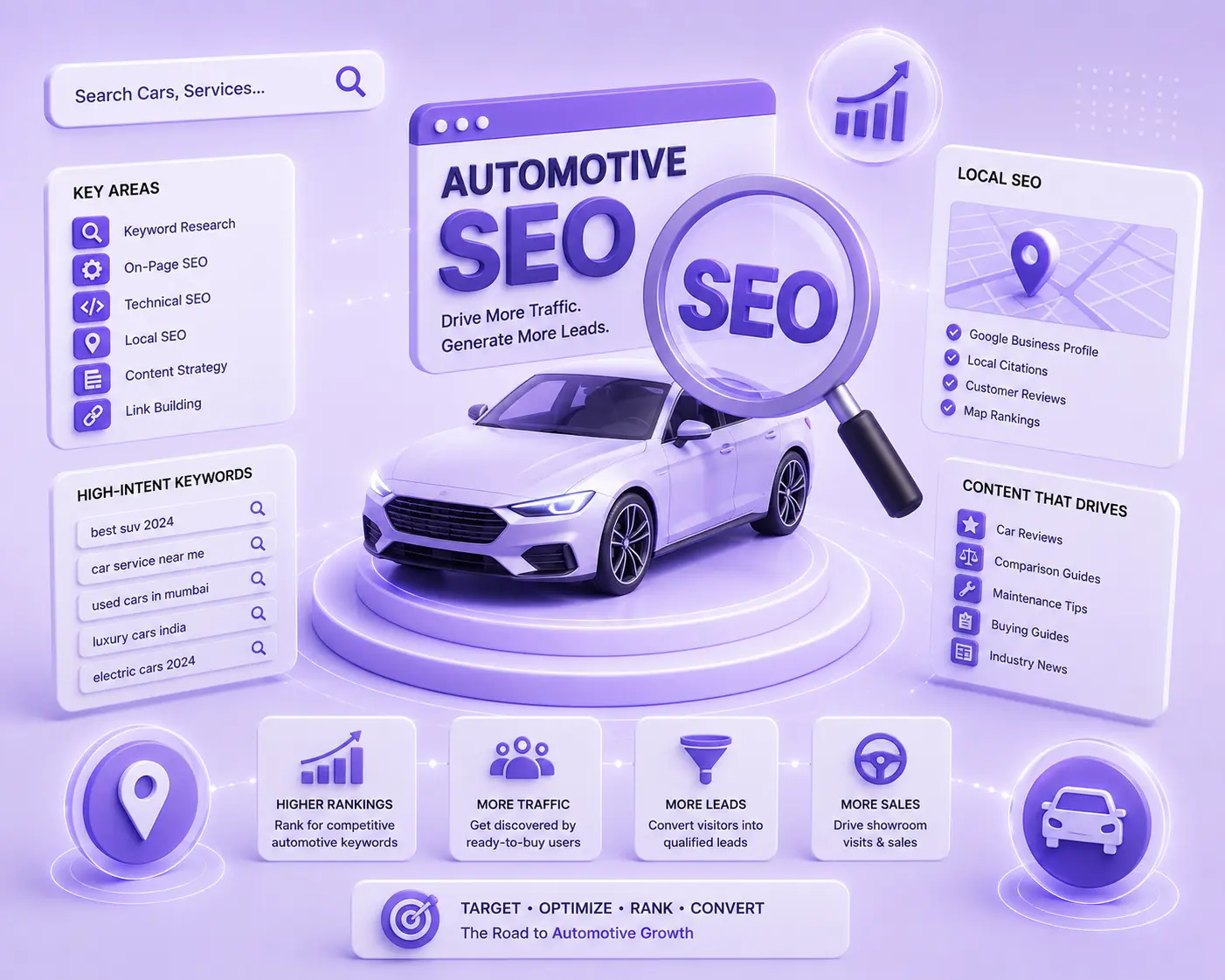
What is Automotive SEO?
Automotive SEO is the practice of optimising car dealer websites, repair shops, parts sellers, and automotive brands to rank higher in organic search results — capturing buyers throughout a uniquely long and complex purchase journey. According to Google, 92% of car buyers research online before making a purchase. Without organic visibility, you simply do not exist for the majority of your potential market.
What makes automotive SEO different from general SEO is the nature of the product and the buyer. Nobody impulse-buys a vehicle. Cox Automotive research shows buyers spend 14 hours and 39 minutes researching online before purchasing. They visit multiple sites, compare models, read reviews, watch walkaround videos, and check local inventory — all before stepping into a showroom. Your SEO must support every stage of that journey, not just the final decision.
Automotive SEO operates across three distinct business contexts — each with its own SEO priorities. Dealerships need local visibility, inventory page optimisation, and Google Vehicle Listings integration. Repair shops need service page SEO, Google Business Profile prominence, and review volume. Auto brands and parts sellers need topical authority, content depth, and structured data at scale. The tactics differ; the underlying discipline is the same.
In 2026, automotive SEO has expanded well beyond Google blue links. Buyers are researching on YouTube, Reddit, and AI tools like ChatGPT before they ever visit a dealership website. Despina Gavoyannis, Senior SEO at Ahrefs, puts it directly: ranking on Google is still important, but it is not the only thing that matters anymore. Buyers research with AI tools, watch YouTube walkarounds, and read Reddit threads before making a decision. Your organic strategy must cover all of these surfaces — not just page one.
Why Automotive SEO Is a Revenue-Critical Discipline
Car buyers spend nearly 15 hours researching online. 88% use digital channels. 71% of touchpoints happen on mobile. The brands that own organic visibility at each stage of that journey capture the sale — those that do not, pay for every single click indefinitely.
The 4 Core Pillars of Automotive SEO
Automotive SEO is four interconnected systems that must work together. Weakness in any one pillar limits what the others can achieve. Strong performance across all four is what separates dealerships compounding organic growth from those stuck on page two.
Local SEO & Google Business Profile
For dealerships and repair shops, local SEO is the highest-leverage pillar. Google treats each location as a separate business — each one needs its own optimised Google Business Profile, dedicated location landing page, and consistent NAP citations across directories. Semrush research found a direct correlation between the number of Google Business Profile reviews and map pack ranking position. The map pack appears above organic results for most automotive queries — even when buyers do not include a city name, because Google infers local intent. Parker Evensen, CEO of Honest Digital, points to Christian Brothers Automotive as the benchmark: every individual location operates as an independent GBP with location-specific content, photos, and reviews — not a generic multi-location page. That granularity is what drives map pack dominance across dozens of markets simultaneously.
HIGHEST LEVERAGE — Where most buyers first find youInventory & Page Architecture
Inventory pages are the digital equivalent of your car lot — but most dealer sites treat them as afterthoughts. Ahrefs expert Edward Bate identifies the most common failure: messy vehicle data from inventory management systems generates pages with inconsistent naming, missing specifications, and manufacturer descriptions duplicated across thousands of dealer sites. Google treats this as low-quality duplicate content and ranks it accordingly. The fix is treating inventory pages like ecommerce product pages — each must have unique dealer notes, rich media, clear specifications, and structured CTAs. For high-value commercial keywords like specials and lease deals, Parker Evensen recommends hub-and-spoke architecture: build a specials hub page targeting the broad term, then model-specific specials pages linking back. Dealerships cannot out-domain-rank Cars.com or Edmunds on a single page — but they can build topical authority across a cluster of pages that aggregators will never match.
REVENUE-CRITICAL — Where intent meets conversionStructured Data & Rich Results
Google Search Central provides dedicated Vehicle Listing structured data documentation for automotive sites — a free feature that pushes inventory directly into Google Shopping, Google Maps, and the Cars for Sale section of Google Search. Beyond Vehicle Listings, Adam Heitzman of HigherVisibility highlights a concrete real-world example: Mazda of North Miami added VideoObject schema to their listing pages and now ranks with video rich results directly in SERPs — capturing additional clicks above standard organic listings without changing their ranking position. The same logic applies across all schema types: star ratings, pricing, and availability in search results lift CTR 20-30% while pushing competitors further down the page. In 2026, complete structured data also feeds automotive information into AI Overviews and tools like ChatGPT — brands without schema are simply invisible to AI-driven discovery.
VISIBILITY MULTIPLIER — Unlocks SERPs, Shopping, and AIVideo, Content & Authority
Wyzowl research found 86% of marketers who used video saw increased web traffic, and 87% reported a direct boost in sales. For automotive brands, video is not a content add-on — it is the channel that replaces the test drive for 64% of modern buyers. Ahrefs expert Michelle Tansey recommends embedding video not just on YouTube but directly on listing and model pages to boost engagement signals and time on page. YouTube is the second-largest search engine, and Google pulls automotive YouTube videos directly onto page one for model-specific queries — giving dealerships two ranking placements simultaneously. Beyond video, Search Engine Journal contributor Adam Heitzman identifies E-E-A-T as the most underused authority lever in automotive: mechanics and sales staff writing named, expert content about specific vehicle knowledge outperforms generic agency-written guides. Content that earns editorial backlinks — original market data, local reliability studies, seasonal car care guides — builds the domain authority that eventually lets dealerships compete with aggregators on commercial keywords.
COMPOUNDING MOAT — Builds trust, links, and AI citationThe Automotive SEO Glossary
Automotive SEO has its own vocabulary — from inventory-specific technical concepts to local ranking factors unique to the industry. Understanding these terms is essential for briefing agencies, interpreting reports, and making the right strategic decisions.
A free Google feature that lets dealerships push live vehicle inventory directly into Google Business Profile — making cars eligible to appear in the Google Shopping tab, local map results, and the dedicated Cars for Sale section of Google Search.
One of the few industry-specific features Google offers automotive businesses at no cost. Ahrefs identifies it as a critical missed opportunity for most dealerships — brands using it gain multi-surface visibility that paid ads cannot fully replicate. Setup follows Google Search Central Vehicle Listings onboarding documentation.
The block of three local business listings Google displays above organic search results for queries with local intent — showing business name, rating, address, and hours. Triggers even when buyers omit location names because Google infers local intent from the query.
For most automotive local searches, the map pack captures the majority of clicks before any organic result is seen. Semrush research found a direct correlation between review count on a Google Business Profile and map pack ranking position — making review acquisition a concrete, measurable ranking strategy.
A content structure where a broad hub page targets a head keyword and links to spoke pages targeting related long-tail variations — all linking back to the hub to concentrate authority signals.
Parker Evensen (CEO, Honest Digital) recommends this specifically for automotive specials and lease keywords where aggregators have higher domain authority. A Toyota Specials hub linking to individual model specials pages builds topical authority no aggregator can replicate for your specific inventory — and gives you multiple ranking entry points across the cluster.
The consistent listing of a business name, address, and phone number across directories, review sites, and data aggregators — a foundational local SEO signal Google uses to validate business legitimacy and location accuracy.
Inconsistent NAP data across Edmunds, Cars.com, JustDial, and Google Business Profile confuses the local algorithm and suppresses map pack rankings. Multi-location dealerships are especially vulnerable — each location needs its own independent, consistent citation profile across every platform.
The continuous cycle of vehicles being added and sold, which creates constant SEO maintenance challenges — sold cars generating 404 errors, thin pages, broken internal links, and crawl budget waste if not managed proactively.
Edward Bate (SEO Consultant, edwardbate.com) identifies inventory data quality as the most common technical failure point for dealer sites. Messy inventory data — inconsistent naming, missing VINs, duplicated manufacturer descriptions — dilutes rankings across the entire site and must be audited before scaling content investment.
Google quality evaluation framework applied through Search Quality Rater guidelines. For automotive, it means demonstrating genuine expertise through named authors, certified credentials, service history transparency, and authentic customer outcomes — not generic agency copy.
Adam Heitzman (SEJ/HigherVisibility) highlights Edmunds as the automotive E-E-A-T benchmark — named expert reviewers with automotive credentials on every review page. Individual dealerships publishing content authored by their own mechanics and sales staff outrank generic buying guides over time because they demonstrate genuine first-hand experience.
How to Build a Winning Automotive SEO Strategy
Six moves in sequence — from locking down your local presence and fixing technical foundations to building the inventory architecture, structured data, and content authority that compound month over month.
Success Metrics That Actually Matter
Automotive SEO reporting must connect organic activity to commercial outcomes — enquiries, test drive bookings, and vehicle sales. Rankings are directional signals; these four metrics tell you whether your SEO is actually driving the business.
The Mindset Shift Automotive SEO Requires
The biggest mistake automotive businesses make with SEO is treating it as a one-time technical project. Audit the site, add some schema, write a few blog posts — then wait six months. That approach does not match how automotive search compounds, and it does not match how automotive buyers actually behave.
Every review collected today makes your map pack ranking stronger next month. Every vehicle listing optimised today continues driving impressions as long as that model is in your inventory. Every buying guide published today earns links and rankings that bring in buyers for years. The compounding effect is what makes SEO the highest long-term ROI channel in automotive — but only when it is treated as ongoing infrastructure, not a quarterly campaign.
The brands winning automotive search in 2026 understand something their competitors are missing: Google is no longer the only channel that matters. Despina Gavoyannis of Ahrefs identifies what she calls search everywhere optimisation — buyers are researching on Reddit threads, watching mechanic walkarounds on YouTube, asking ChatGPT which SUV has the best reliability record, and scrolling TikTok for real owner reviews before they ever visit a dealership website. Your brand needs to be present and credible across all of these surfaces.
The shift is from thinking about ranking to thinking about presence. A ranking is a number on a report. Presence is what buyers experience at every point of their 14-hour research journey — whether they find you on Google Maps, a YouTube walkaround, an AI Overview citing your buying guide, or a Reddit thread where your head mechanic answered a question two years ago. SEO builds that presence. No other channel compounds in the same way.
Ready to Turn Your Dealership's Organic Presence Into a Revenue Engine?
Search Indicators audits your local SEO foundation, inventory page quality, structured data coverage, and organic share of voice across your market — and builds the strategy that compounds month over month.