Search hasn’t “died,” but the surface area of discovery has exploded. Links and blue SERP listings now share the stage with AI-generated answers, summaries, and side panels that short-circuit the click entirely. Traditional SEO alone can’t guarantee visibility in this new layer.
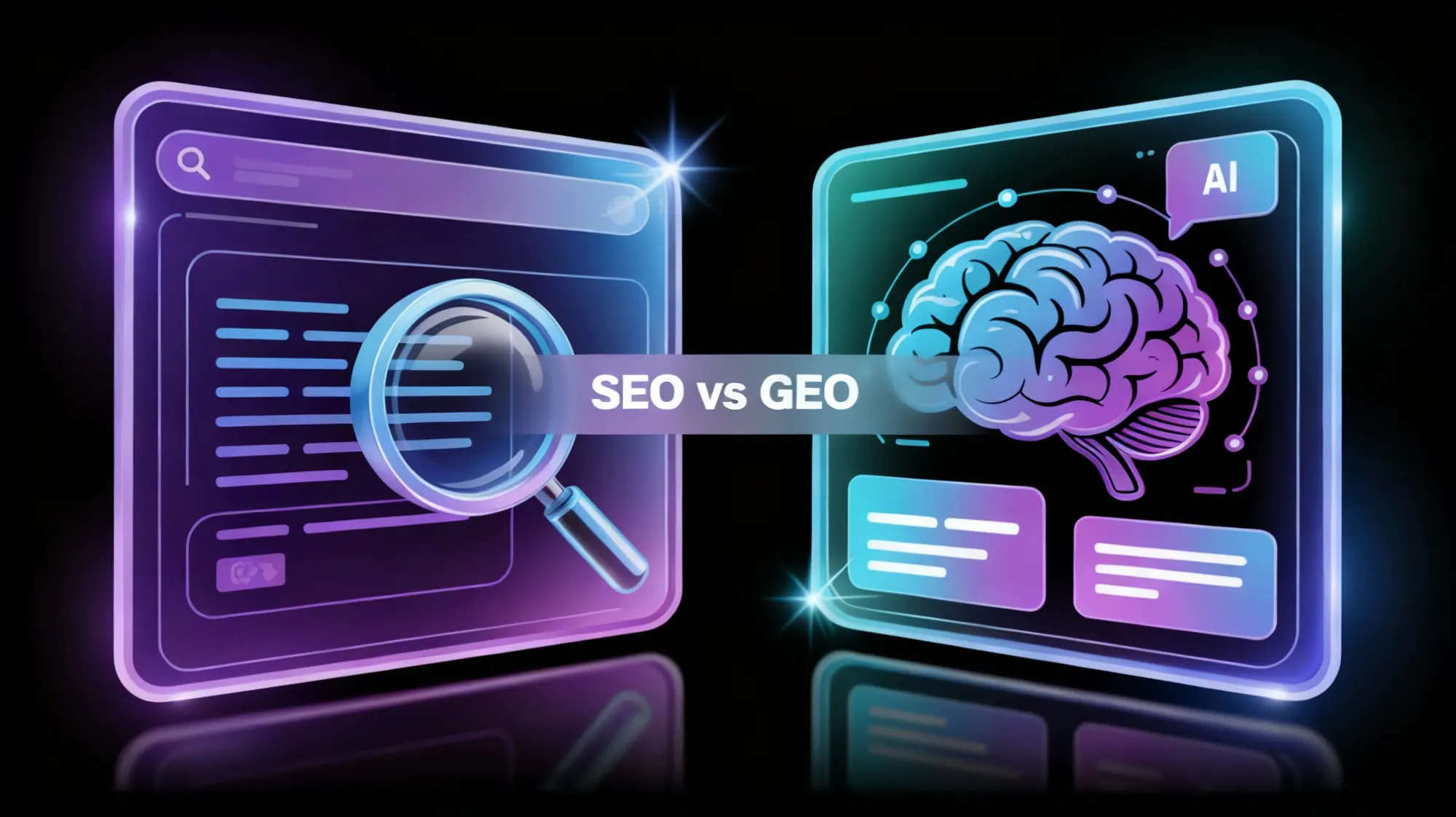
This article unpacks GEO (Generative Engine Optimization) vs SEO (Search Engine Optimization) ; what’s changing, what isn’t, and how to practically transform your strategy so your brand shows up in both Google and AI engines.
Key Takeaways
- SEO optimizes for ranked links; GEO optimizes for cited answers.
- SEO is still the foundation of GEO. Clear information architecture, authoritative content, and clean technical SEO are strongly correlated with visibility in AI responses.
- GEO adds a new layer of optimization: entity clarity, machine-scannable justification (stats, quotes, sources), and strong earned-media coverage that AI engines prefer to cite.
- Generative engines are biased toward authoritative third-party sources. Studies show AI search tends to favor high-authority media and reference domains over brand-owned content, especially for generic queries.
- You don’t “replace” SEO with GEO ; you extend it. The winning approach is a stacked strategy: solid SEO for SERPs + GEO-aware content, schemas, and PR to earn citations in AI.
- Transformation requires new KPIs. Stop only tracking rankings and sessions; start tracking citation share in AI outputs, entity coverage, and brand mentions in generative answers.
- Need governance around AI visibility. GEO touches brand safety, hallucinations, and misinformation ; someone needs to own monitoring and escalation when AI “gets you wrong.
GEO vs SEO: Key Differences & Overlaps
At a high level, SEO and GEO both try to do one thing: help the right people find trustworthy answers, and ideally, find you. The difference is where and how those answers are delivered.
| Area | SEO (Search Engine Optimization) | GEO (Generative Engine Optimization) |
|---|---|---|
| Primary Surface | Google/Bing SERPs (10 blue links, snippets, rich results) | AI Overviews, ChatGPT, Gemini, Perplexity, AI sidebars, conversational UIs |
| Main Outcome | Clicks to your site from ranked listings & snippets | Mentions, citations, recommendations inside AI-generated answers |
| Visibility Metric | Rankings, impressions, CTR, organic sessions | Citation share, answer inclusion rate, brand mentions in AI responses |
| Optimization Targets | Keywords, pages, site architecture, backlinks | Entities, sources, machine-scannable explanations, structured facts, earned media authority |
| Ranking Logic | Link graphs + relevance + quality signals | Model training data + retrieval sources + authority priors + safety filters |
| Time Horizon | Months to build; relatively stable once established | Dynamic; sensitive to model updates, training cutoffs, retrieval index changes |
| Who Benefits Most | Sites with strong domain authority & good technical/content hygiene | Brands & entities with rich multi-surface presence (owned + earned + reference sites) |
What’s Actually Changing in Search
1. Zero-click, but more extreme.
Traditional featured snippets already reduced clicks. AI Overviews and chat answers often satisfy the query without any click at all. You still need visibility ; but the win is now being named, not only being clicked.
2. Model-level memory and training.
Engines don’t just “look at the live web.” They also rely on training data snapshots, retrieval indexes, and curated sources. Your old content and third-party coverage can influence AI answers long after you’ve published.
3. Bias toward trusted authorities.
Studies of AI search reveal systematic preference for earned media and reference domains ; think large publishers, government sites, well-known industry resources ; especially for YMYL topics.
4. Hallucinations and misalignment risk.
AI can still misrepresent your pricing, product positioning, or even claim things you never said. That’s a brand risk and a legal/compliance concern, not just a traffic issue.
How to Evolve From SEO to GEO (Without Burning Down Your SEO)
Actionable Steps ; A GEO-First Upgrade Path
Start with a structured transformation:
- Audit your AI visibility (baseline).
- Ask AI engines about your category, your brand, your competitors.
- Track: Are you cited? How are you described? Which sources does the AI lean on?
- Document recurring domains (e.g., top blogs, review sites, directories). That’s your GEO surface map.
- Ask AI engines about your category, your brand, your competitors.
- Harden your entity and brand signals.
- Standardize your brand name, product names, founders, locations across all properties.
- Update key profiles (Wikipedia if applicable, Crunchbase, G2/Capterra, LinkedIn, major directories).
- Use structured data (Organization, Product, Service, Person schemas, etc.) consistently to help machines understand relationships.
- Standardize your brand name, product names, founders, locations across all properties.
- Re-architect content for “machine justification.”
- Add clear stats, quotes, and short, factual sentences that can be safely reused by AI (e.g., “Our platform processes over 2M invoices per month.”).
- Use FAQ blocks, comparison tables, and bullet lists that make it easy for models to extract discrete facts.
- Ensure every key claim is backed by a source, ideally with outbound citations to authoritative references (research, standards, regulators).
- Add clear stats, quotes, and short, factual sentences that can be safely reused by AI (e.g., “Our platform processes over 2M invoices per month.”).
- Double-down on earned authority.
- Launch or refine a digital PR program: guest posts, expert quotes in media, independent reviews, industry reports.
- Target the domains you saw repeatedly in your GEO audit. If AI trusts them, you want them talking about you.
- Launch or refine a digital PR program: guest posts, expert quotes in media, independent reviews, industry reports.
- Align topic strategy with AI demand.
- Research the questions people are actually asking AI in your niche (e.g., through user interviews, search logs, and SERP features).
- Build content clusters around problem-first queries, not just classic “best [tool]” or “what is [term]” keywords.
- Research the questions people are actually asking AI in your niche (e.g., through user interviews, search logs, and SERP features).
- Implement AI-aware technical practices.
- Consider emerging standards like llms.txt or AI-specific metadata where appropriate, to signal how your content can be used.
- Maintain excellent crawlability, sitemaps, and schema ; most AI engines still use web crawling + retrieval as a foundation.
- Consider emerging standards like llms.txt or AI-specific metadata where appropriate, to signal how your content can be used.
Treat GEO upgrades as new acceptance criteria for content and PR, not a separate project.
- Include 2;3 machine-scannable stats.
- Reference external authoritative source.
- Implement contextual schema markups.
GEO vs SEO Isn’t Either/Or ; It’s Your New Stack
If SEO was about showing up where people search, GEO is about showing up where machines answer.
- SEO is not dead; it’s the base layer.
- Generative engines are now a parallel layer of discovery where decisions are increasingly made.
- GEO doesn’t replace SEO ; it extends it into the AI era, with new surfaces, new metrics, and new risks.
As a founder, CMO, or growth leader, your job is to:
- Acknowledge the shift (links → language, rankings → citations).
- Audit your current presence in AI answers.
- Upgrade your content, entities, and earned media to be machine-friendly and citation-worthy.
- Put governance around AI visibility, not just around ads and social.
FAQs: GEO vs SEO
Is GEO replacing SEO?
No. GEO builds on top of SEO rather than replacing it. You still need a crawlable, fast, well-structured site with authoritative content. GEO adds a focus on how AI engines ingest, interpret, and reuse that content (plus your broader online footprint) in generated answers.
How do I know if we have a GEO problem?
You likely have a GEO problem if:
- AI engines barely mention your brand for key category queries.
- Competitors appear in AI shortlists despite weaker traditional SEO.
- AI answers misstate your pricing, features, or positioning.
A simple test: run your top 20;30 queries through ChatGPT, Gemini, Perplexity, and (where available) AI Overviews. If you’re invisible or misrepresented, GEO needs attention.
What are the first 3 practical steps to start with GEO?
- Run a cross-engine AI visibility audit for your key queries.
- Standardize your entity footprint (brand names, product names, profiles, schemas).
- Upgrade your top 10;20 pages to be GEO-ready: clear definitions, structured facts, stats, external citations, and robust EEAT signals.
How do you measure GEO success?
- Citation rate: % of test prompts where your brand appears.
- Accuracy score: How correctly AI engines describe your offering.
- Source diversity: Number and quality of third-party domains through which AI “knows” you.
- Overlap vs competitors: How often you appear instead of or alongside key competitors.
Is GEO only relevant for big brands?
No ; but big brands start with a structural advantage because they already dominate earned media and reference sites. Smaller brands can compete by:
- Owning narrow, high-intent niches deeply.
- Building strong expert-level content and EEAT.
- Partnering with trusted publications to gain authoritative mentions.